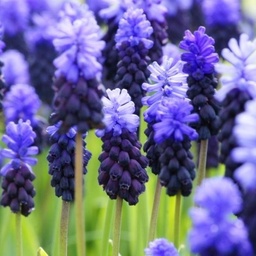
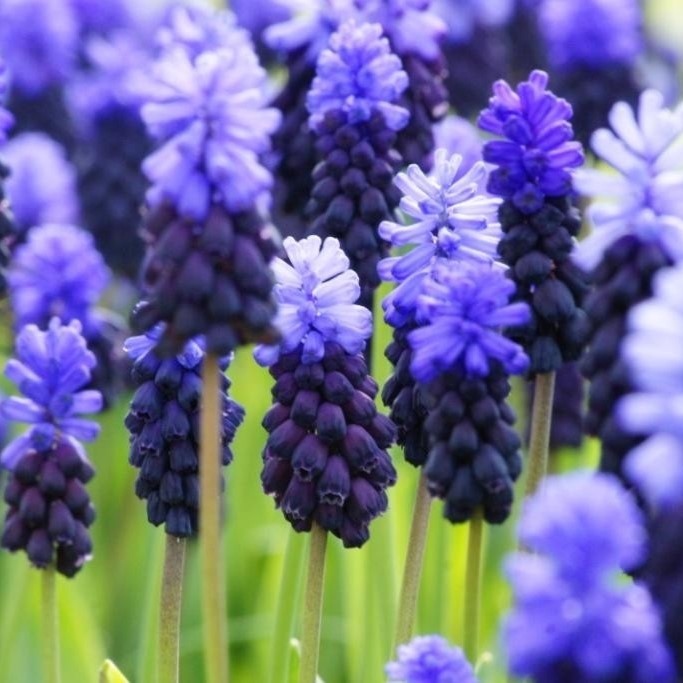
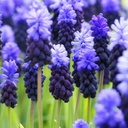
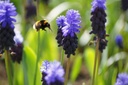
The name ‘Latifolium’ already refers to its broad leaves – more striking than the narrow leaves of the common Muscari. But what really sets it apart is the flower itself: dark blue at the base, light blue at the top. Two shades on a single stem, like a miniature ombre effect. A surprising addition that always deserves a second look in the border.
The best underplanting for tulips
Muscari Latifolium flowers in mid-spring, just when most tulips are in bloom. That timing is no coincidence – it combines beautifully with them. Blue beneath red, orange or white tulips creates a colour contrast that instantly brings the border to life. It also works well in a pot: a layer of Muscari latifolium on top of a layer of tulip bulbs creates a full, professional-looking result.
Planting and naturalising
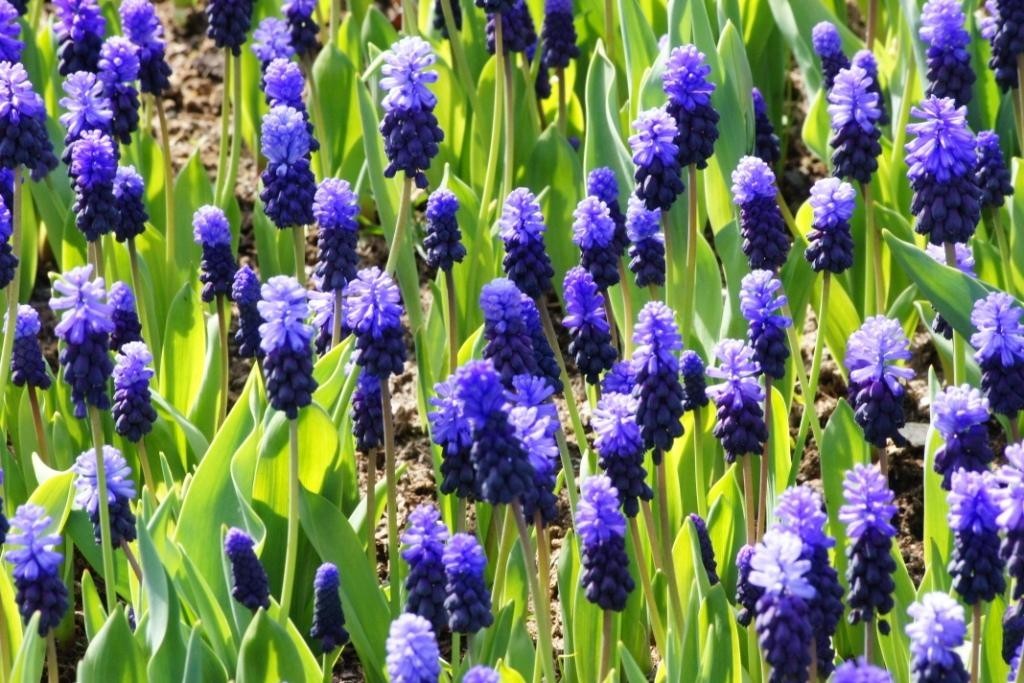
Plant the bulbs in autumn at a depth of 8–10 cm, in groups of at least ten for the best effect. They grow in sun or partial shade and are not fussy about soil type. Once planted, the Latifolium naturalises itself – it returns every year and spreads slowly. Allow the broad foliage to die back after flowering before removing it. Organically grown, certified NL-BIO-01.



![[A9001] Grape Hyacinth - Muscari Armeniacum - ORG](/web/image/product.template/7431/image_512/%5BA9001%5D%20Grape%20Hyacinth%20-%20Muscari%20Armeniacum%20-%20ORG?unique=920c0de)
![[A9001] Grape Hyacinth - Muscari Armeniacum - ORG](/web/image/product.template/7431/hover_image/%5BA9001%5D%20Grape%20Hyacinth%20-%20Muscari%20Armeniacum%20-%20ORG?unique=920c0de)
![[A9073] Grape Hyacinth - Muscari Early Bird - ORG](/web/image/product.template/14709/image_512/%5BA9073%5D%20Grape%20Hyacinth%20-%20Muscari%20Early%20Bird%20-%20ORG?unique=05f8489)
![[A9063] Grape Hyacinth - Muscari White Magic - ORG](/web/image/product.template/7429/image_512/%5BA9063%5D%20Grape%20Hyacinth%20-%20Muscari%20White%20Magic%20-%20ORG?unique=533c604)
![[A9035] Muscari Mix Blue-White - ORG](/web/image/product.template/7427/image_512/%5BA9035%5D%20Muscari%20Mix%20Blue-White%20-%20ORG?unique=fd4fa5a)