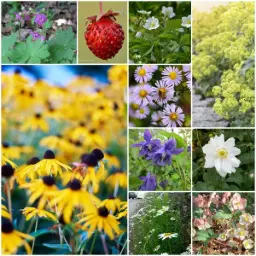
Perennial package for partial shade 4 m² - ORG
Reference: B7903-BP
Flowering from January (!) to October in your semi-shaded border
- Edible plants
- Suitable for difficult, semi-shaded spots
- Returns every year
- 100% organic
The perennial season is over. Starting in January, perennials will be available for pre-order again.

Natural Bulbs
-

100% Organic NL-BIO-01
Detail
Partial shade has a bad reputation. Too little sun for common garden plants, too much sun for true woodland plants. It’s the in-between zone that gardeners most often overlook. Yet it is precisely in these spots—under a tree, along a fence or next to an extension—that some of the most beautiful perennials in existence thrive.
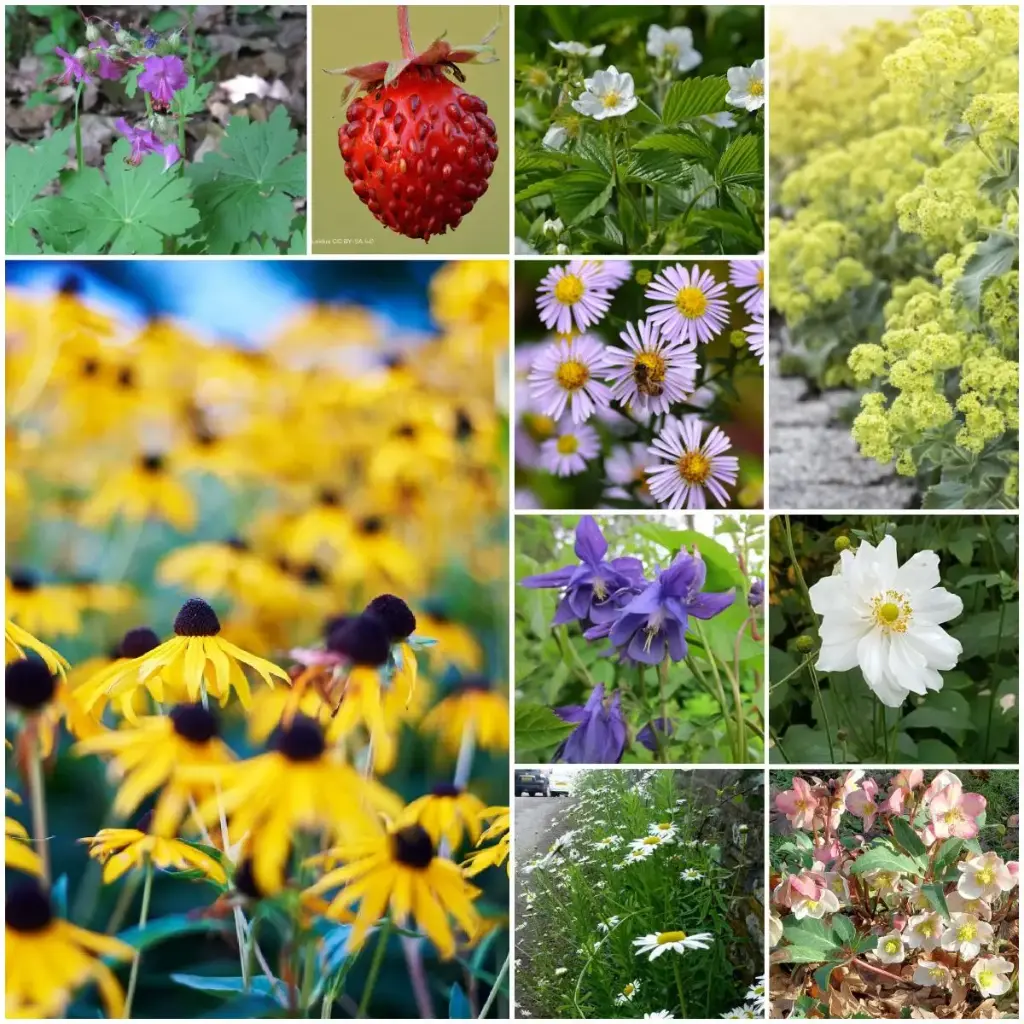
This pack has been put together for precisely that situation. Nine varieties that don’t merely tolerate partial shade, but positively thrive in it. Together, they create a border that flowers from deep into winter right through to late autumn. A feat that most fully sunny borders don’t even manage.
Nine varieties that embrace the shade
There is something magical about the way lady’s mantle holds water droplets. The velvety, fan-shaped leaves hold morning dew like mercury, a sight most gardeners remember. The yellow-green flower plumes that appear in summer are graceful and airy, and combine with almost anything in the border. Lady’s mantle is also one of the most reliable groundcovers you can choose: it grows densely, keeps weeds at bay and requires virtually no maintenance.

As October approaches and most borders look a bit tired, the balsam aster bursts into bloom in shades of purple, pink and blue. A sea of tiny stars on sturdy stems, and above them: bees, bumblebees and butterflies making the most of the last warm days of the year. The balsam aster is one of the most important plants for pollinators in the autumn, as there are few alternatives left by then. Combined with the black-eyed Susan and the Japanese anemone, it ensures that the border ends with a bang, not a whisper.

The columbine is the dancer of the garden. Light, feathery leaves on slender stems, and above them flowers that look as though they were designed by someone who loves exuberance: spurs on the petals in blue, purple, pink or white, depending on the variety. Columbine flowers in early spring and is one of the few plants that long-tongued bumblebees really need — only they can reach the nectar deep within the spurs. Afterwards, it kindly self-seeds and surprises you in a slightly different spot every year.

Bright white with a yellow centre. The daisy is one of the most recognisable flowers in existence, and with good reason. It flowers for a long time, looks great in a vase, and attracts insects like a magnet. In a semi-shaded border, it brings light and brightness to the areas where it is most needed. There is also something reassuring about the daisy: it simply does what it always does, year after year, without drama and without demanding attention.

Not to be confused with the pot plant that garden centres put out in the summer. The true cranesbill is a perennial of a completely different order: long-lived, fully hardy, and capable of flowering almost continuously from May to September. The small flowers in blue, pink or purple seem innocent, but provide a reliable source of nectar for bees and bumblebees throughout the growing season. What’s more, it covers the ground in a way that gives weeds no chance — practical and beautiful.

Once summer has passed its peak and most plants have finished flowering, the black-eyed Susan really comes into its own. The bright yellow flowers with their dark, cone-shaped centres appear in August and last well into autumn. Rudbeckia is one of the best late-flowering plants for semi-shaded borders and brings back a sense of warmth at the end of the season. Bumblebees and bees, which are increasingly desperate for food in late summer, gratefully benefit from this.

The Japanese anemone has something unexpected about it. Whilst the garden is slowly winding down, it does the opposite: the slender stems with their graceful pink or white flowers appear in August and continue to bloom until October. The Japanese anemone belongs in a semi-shaded border — it originates from the forest edges of China and Japan, and thrives best in a spot where the sun does not beat down all day. Once planted, it spreads gently and returns slightly larger each year.

Small, sweet and edible, the wild strawberry is the surprise in this pack. The white flowers appear early in spring and attract bees at a time when few other plants are in bloom. These are followed by small, flavourful strawberries that you can pick straight from the plant. Wild strawberries spread gently via runners, forming a dense, cheerful ground cover. Along with the lenten rose, they prove that an organic border can also be edible.

January. In the middle of winter, when the rest of the garden stands bare and still, the lenten rose opens its first flowers. That is no mistake — it is its nature. Helleborus prefers to flower during the cold months, and keeps going well into spring. The deeply cup-shaped flowers in cream, pale pink or purplish tones are elegant and understated, exactly what you want to see on a grey February day. In a semi-shaded border, the Helleborus is the anchor that opens the season, long before the other plants even begin to stir.

From January to October, flowers every month
All nine varieties in this pack are perennials: plant them once, and they’ll come back on their own every spring. The selection is designed so that something is in bloom almost all year round: the lenten rose opens in January, the columbine and cranesbill take over in spring, the daisy and lady’s mantle bloom throughout the summer, and the black-eyed Susan, Japanese anemone and balsam aster round off the season. Even after the last flower has faded, the dry flower heads of the rudbeckia and aster still stand gracefully in winter.
A border that attracts life, even in the shade
Part-shade plants have a reputation for being less interesting to insects than sun-loving varieties. That is not true. The columbine is indispensable for long-tongued bumblebees. Cranesbill flowers for months on end and provides bees with nectar throughout the season. Wild strawberries attract early pollinators. And balsam asters and Rudbeckia’s are a real lifeline in autumn for bumblebees and bees, who are finding it increasingly difficult to find food. Together, they form a chain of flowering that supports insects all year round.
Planting advice for the partial shade border
Part-shade plants thrive in well-drained, humus-rich soil. Working in a handful of compost before planting gives them a good start. Space them 25 to 30 centimetres apart, and plant the taller varieties — balsam aster, rudbeckia and Japanese anemone — at the back. Wild strawberries and lady’s mantle work well in the foreground as ground cover.
Most varieties in this pack are drought-tolerant once they have established themselves, but they deserve a little extra care and water in the first few weeks after planting.
Certified organic, naturally robust
No artificial fertilisers, no pesticides. All 36 plants are organically grown under the NL-BIO-01 certification and are supplied in a half-litre P9 pot. Organically grown plants are naturally more robust — they have grown without artificial support and are therefore better able to withstand changing conditions in the open ground.
Main characteristics
Height | Colour | Flowering time | |
Alchemilla Mollis | 30-45 cm | Yellow-green | May - June |
Aster Asran | 40-80 cm | Purple | August - September |
Aquilegia Alpina | 40-70 cm | Purple | May - July |
Leucanthemum Vulgare | 30-70 cm | White | May - August |
Geranium Macrorrhizum | 20-50 cm | Purple | May - June |
Rudbeckia Goldsturm | 60-90 cm | Yellow | August - October |
Anemone Honorine Jobert | 80-120 cm | White | August - October |
Fragaria Vesca | 5-20 cm | Green, white, red | April - September |
Helleborus Orientalis | 30-50 cm | Pink | January - April |
Alternative Products
![[B7904-BP] Perennial package for Shadow 1 m² - ORG](/web/image/product.template/15479/image_512/%5BB7904-BP%5D%20Perennial%20package%20for%20Shadow%201%20m%C2%B2%20-%20ORG?unique=1c2159c)
![[B7905-BP] Perennial package for Shadow 4 m² - ORG](/web/image/product.template/15480/image_512/%5BB7905-BP%5D%20Perennial%20package%20for%20Shadow%204%20m%C2%B2%20-%20ORG?unique=1c2159c)
![[B7900-BP] Perennial package for Sun 1 m² - ORG](/web/image/product.template/15477/image_512/%5BB7900-BP%5D%20Perennial%20package%20for%20Sun%201%20m%C2%B2%20-%20ORG?unique=1c2159c)
![[B7901-BP] Perennial package for Sun 4 m² - ORG](/web/image/product.template/15478/image_512/%5BB7901-BP%5D%20Perennial%20package%20for%20Sun%204%20m%C2%B2%20-%20ORG?unique=1c2159c)
![[B7902-BP] Perennial package for partial shade 1 m² - ORG](/web/image/product.template/15471/image_512/%5BB7902-BP%5D%20Perennial%20package%20for%20partial%20shade%201%20m%C2%B2%20-%20ORG?unique=1c2159c)
Product Features
| Uncategorized |
|---|