Perennial package for Shadow 4 m² - ORG
Reference: B7905-BP
Even the darkest spot in your garden deserves a lovely border
- Flowers from January to October
- Excellent ground cover plants
- Perennial and hardy
- 100% organic
The perennial season is over. Starting in January, perennials will be available for pre-order again.

Natural Bulbs
-

100% Organic NL-BIO-01
Detail
In the world of gardening, full shade is considered the most challenging growing environment. No sun, little light, and often dry soil due to overhanging trees. Most gardeners give up and lay down bark or gravel. But beneath the surface of that problem lies something beautiful: there is a whole world of perennials that thrive precisely in these kinds of conditions — and which would never fare so well in a sunny border.
This pack has been put together for just such a spot. Seven varieties that don’t merely tolerate the shade, but are right at home there. Together, they give four square metres a character that a sunny border can never match: lush, green, deep and almost woodland-like — with flowers that surprise you when you least expect them.
Seven plants that thrive in the shade
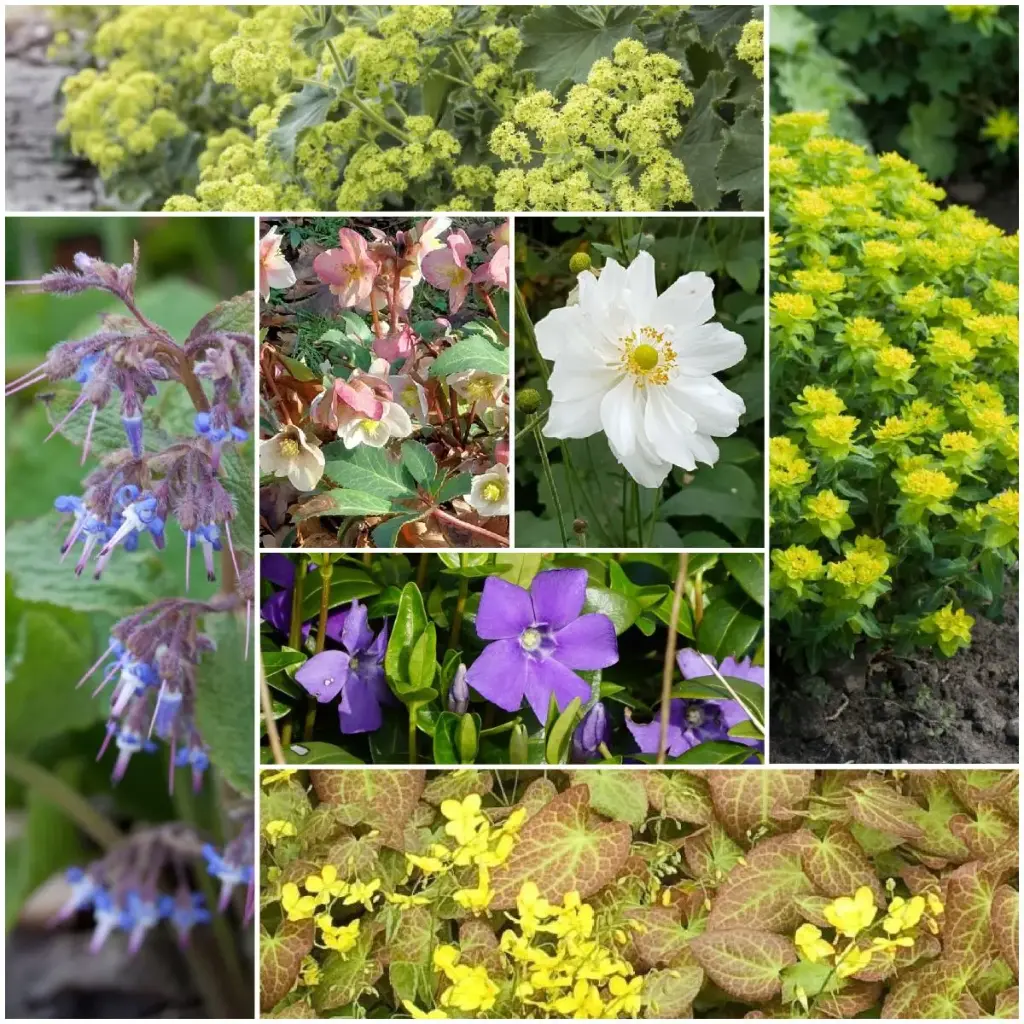
Raindrops gather on the velvety leaves of lady’s mantle like mercury — a sight that always leaves a lasting impression. The yellow-green flower panicles appear in summer and are airy and graceful, blending effortlessly with the darker scents and colours of the other shade-loving plants. As a ground cover, lady’s mantle is one of the most reliable choices: it grows densely, suppresses weeds and is hardy without reservation.

At the end of the season, when the summer flowers have long since faded, the Japanese anemone makes its entrance. The slender stems bear graceful white or pink flowers that glow in the shade — an effect that is almost magical during the day, and even more so at dusk. The Japanese anemone occurs naturally on forest edges in China and Japan, and feels perfectly at home in a shade border. It spreads gently and returns stronger every year.

The barrenwort is one of the most underrated perennials in existence. Its heart-shaped leaves turn red and bronze in autumn, and the small flowers that appear in spring are delicate and unexpectedly graceful. Epimedium grows slowly but surely into a dense mat that gives weeds no chance. It tolerates dry shade better than almost any other perennial, and requires virtually no maintenance year after year.

Architectural, unusual and immediately striking. In spring, the spurge bears large, graceful clusters of yellow-green petals that look as though they come from a different climate — and that is partly true, as many Euphorbia species originate from Mediterranean regions and Asian mountain areas. In a shade border, it brings structure and a splash of colour at a time when many other plants are barely awake. Please note: the sap of the spurge is irritating to the skin; wear gloves when pruning.

A striking addition to the border: the Trachystemon is a climbing, tuberous plant from East Asia that stands out with its large, soft leaves and small yellow flowers in summer. It is ideal for shady spots along a wall or fence, where it climbs up gracefully. A plant that sparks curiosity among visitors is a quality in itself.

Green, evergreen, and indestructible. Periwinkle is the ideal ground cover for shady spots: it covers the ground all year round with glossy leaves, flowers in spring with lilac-blue star-shaped blooms, and spreads slowly but surely via runners. Bees gratefully visit the early flowers — in April there are few other sources of nectar available in a shaded border. Once planted, periwinkle requires virtually no attention and returns year after year.

Whilst the rest of the garden is still dormant, the lenten rose opens its flowers as early as January. Helleborus is one of the few perennials that seeks out the cold rather than avoiding it. The cup-shaped flowers in cream, pink or dark purple hang slightly downwards, as if protecting themselves from the elements, and persist well into spring. In a shade border, the hellebore is the first sign of life, and it fulfils this role with elegance.

Flowers from January to October, even without direct sunlight
All seven varieties in this pack are perennials and fully hardy: plant them once, and they will return naturally every spring. The flowering times have been chosen so that there is something to see throughout the season, from the first hellebore flowers in January to the last Japanese anemones in October. In between, barrenwort, spurge and lady’s mantle provide colour and texture, whilst periwinkle keeps things green all year round.
Shade is not an obstacle, it is a habitat
Full shade has its own ecology. In early spring, bees and bumblebees find nectar in the periwinkle and hellebore, at a time when sunny borders offer hardly anything. Barrenwort and Japanese anemone add to this later in the season. Together, these seven species form a chain of flowering that supports insects from early spring right into late autumn — all whilst growing in the part of the garden that most people give up on.
How to give your shade border the best start
Shade-loving plants thrive best in loose, moist, humus-rich soil. Before planting, work well-rotted compost thoroughly into the soil — especially under trees, where the soil is often dry and nutrient-poor. Space the plants 25 to 30 centimetres apart and plant the taller varieties (Japanese anemone, spurge) at the back.
In the first few weeks after planting, the plants will need a little extra water, especially during dry spells. Once they have taken root, most varieties in this pack are remarkably drought-tolerant for shade plants — particularly the barrenwort and periwinkle.
Organically grown, ready for the open ground
No artificial fertilisers, no pesticides, no shortcuts. All 36 plants are certified organically grown under the NL-BIO-01 label and are supplied in a half-litre P9 pot. Small in size, but with a root system ready for the transition to the open ground.
Main characteristics
Height | Colour | Flower time | |
Alchemilla Mollis | 30-45 cm | Yellow green | May - June |
Anemone Honorine Jobert | 80-120 cm | White | August - October |
Epimedium Perralchicum | 20-40 cm | Yellow | April - May |
Euphorbia Polychroma | 20-40 cm | Yellow | April - June |
Trachystemon Orientalis | 100–200 cm | Yellow | June - August |
Vinca Minor | 10–20 cm | Purple, blue | March - May |
Helleborus Orientalis | 30-50 cm | Pink | January - April |
Alternative Products
![[B7904-BP] Perennial package for Shadow 1 m² - ORG](/web/image/product.template/15479/image_512/%5BB7904-BP%5D%20Perennial%20package%20for%20Shadow%201%20m%C2%B2%20-%20ORG?unique=1c2159c)
![[B7900-BP] Perennial package for Sun 1 m² - ORG](/web/image/product.template/15477/image_512/%5BB7900-BP%5D%20Perennial%20package%20for%20Sun%201%20m%C2%B2%20-%20ORG?unique=1c2159c)
![[B7901-BP] Perennial package for Sun 4 m² - ORG](/web/image/product.template/15478/image_512/%5BB7901-BP%5D%20Perennial%20package%20for%20Sun%204%20m%C2%B2%20-%20ORG?unique=1c2159c)
![[B7902-BP] Perennial package for partial shade 1 m² - ORG](/web/image/product.template/15471/image_512/%5BB7902-BP%5D%20Perennial%20package%20for%20partial%20shade%201%20m%C2%B2%20-%20ORG?unique=1c2159c)
![[B7903-BP] Perennial package for partial shade 4 m² - ORG](/web/image/product.template/15476/image_512/%5BB7903-BP%5D%20Perennial%20package%20for%20partial%20shade%204%20m%C2%B2%20-%20ORG?unique=1c2159c)
Product Features
| Uncategorized |
|---|